
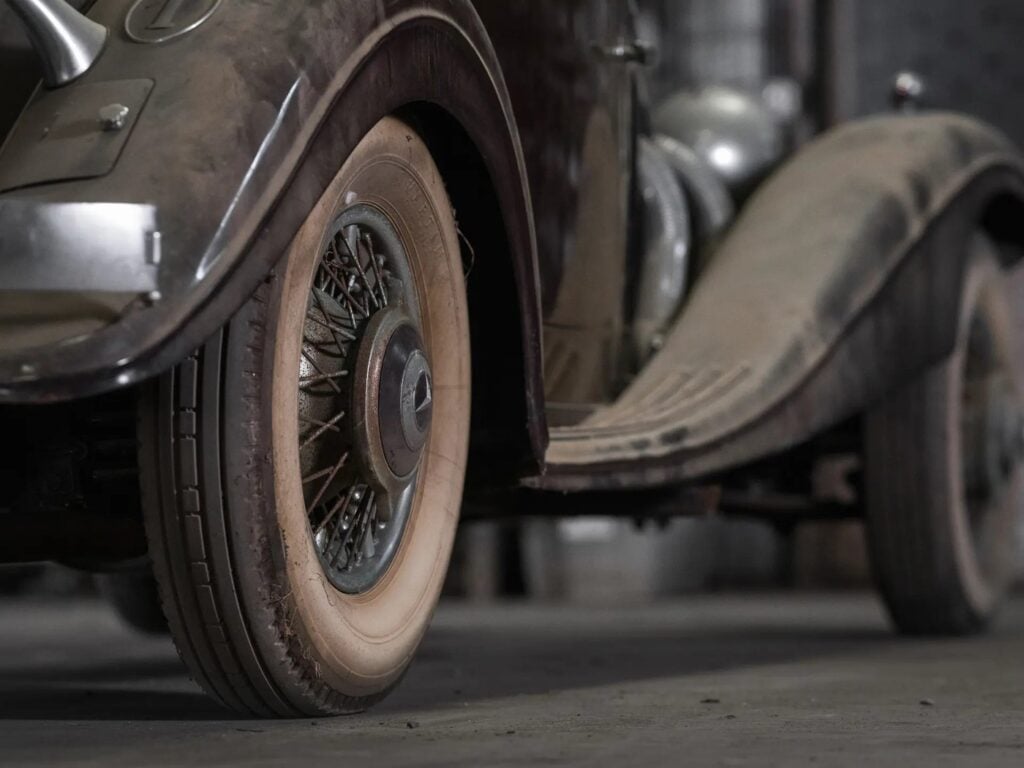
The tyres, CALIFORNIA, USA, A ONE OFF car built for Mercedes-Benz’s legendary champion racing driver, Rudi Caracciola is up for auction with no reserve. Images show the striking, 1935 Mercedes-Benz 500 K 'Caracciola' Special Coupe, in all its glory. The car is being offered for sale by Sotheby’s The Junkyard, The Rudi Klein Collection. This vehicle is the single most pursued Full Classic automobile of the last half-century. documented by a copy of its build sheet, bearing Caracciola’s name. Formerly owned by legendary California enthusiasts Dr. Milton Roth and M.L. “Bill” Post and acquired by Rudi Klein in 1979, it has been hidden away and not seen by the public since 1980. This is the long-awaited opportunity to acquire and freshly restore one of the most famous and desired of all Mercedes-Benzes. Currently the vehicle is being offered without reserve and without a listing price. Rudolf Caracciola, born in Germany to Italian parents, who enjoyed cars and so apprenticed at an automobile factory as a young man, eventually became a car salesman for Daimler in Dresden, and in 1926 asked Mercedes-Benz to supply him a car to drive in the first German Grand Prix. The race was beset by drenching rain, which Caracciola hurtled through, even as other drivers literally crashed and died around him. Rudi Caracciola, Regenmeister, and his utterly fearless nature won the day. By the mid-1930s Caracciola, the first non-Italian to win the Mille Miglia, was the star of Mercedes-Benz’s Formula 1 team, occupying a position in the public eye akin to the modern legend of Lewis Hamilton. At the wheel of the famed “Silver Arrows” he accumulated six German Grand Prix trophies, a record which still stands today, as well as three European Driving Championships and three European Hillclimb Championships. In January 1938, at the wheel of a W125, he was clocked at 268.9 mph on the autobahn, which is still the fastest speed ever officially recorded on a public road. Such was the Regenmeister’s level of skill; 86 years later, one of his achievements still stands Following this success Mercedes-Benz built him unique car creation on what was then their ultimate supercharged chassis. “The design of the car was tailored specifically for Caracciola, hence the somewhat taller but nonetheless well-balanced roofline and windshield, accommodating the driver’s height,” states the listing. “The body sat at the end of an almost impossibly long, gorgeous hoodline, it and the fenders unencumbered by awkward spare tires,instead, the spare hung at the rear, at the terminus of bold chromed accent lines that flowed to a point through the curve of the deck lid. “It was a car that emphasised its power. It looked, in fact, like a racing car with a roofline, and that was almost certainly the idea. Befitting an automobile that Mercedes-Benz wanted people to see Caracciola drive, to events all over Europe, it came with room for two passengers, and a luggage set aft of the seats—perfect for a weekend at Reims or Monza. “Significantly, the build sheet clearly lists Caracciola as the receiving original owner, via the dealer in Paris. Caracciola posed with the car and Alfred Neubauer, manager of the Mercedes-Benz Grand Prix team, at Bremerhaven prior to embarking to America for the George Vanderbilt Cup. “Further, the car is known to have been utilised in at least one Mercedes-Benz advertisement in-period. It was, like its driver, a star. “It is believed that Caracciola used the car until the late 1930s, and that it was then resold through the Paris dealer. “Reportedly the new owner was Italian foreign minister Galeazzo Ciano, hence the transplant of the original “D” on the rear fender with “I” for Italy, but this is not documented. “Tom Hanson, son of the 500 K’s eventual restorer, recounted to Car and Driver in 2012 that the car had somehow wound up “in Ethiopia, where it was covered in tarpaulins and hidden in a manure pile.” Reportedly the car was purchased out of this situation in the early 1960s by Dr. Milton Roth, a Long Beach dentist best remembered as an early and avid “Bugattiste.” Soon after the Mercedes-Benz arrived, in the fall of 1963, Dr. Roth passed away, and the 500 K changed hands through a couple of brief ownerships in Southern California. It wound up with Matthew L. “Bill” Post, a prominent enthusiast who was co-founder with Bud Cohn of the Le Cercle Concours, at one time the most prestigious vintage automobile event in the area. Post brought the car to restorer Dale Hanson, who spent 16 months undertaking a complete restoration, matching the original maroon finish and leather interior to traces of original materials still in place on the car.,Image: 908149266, License: Rights-managed, Restrictions: , Model Release: no, Credit line: mediadrumimages/Patrick Ernzen/r / Media Drum World / Profimedia
Automobilul autonom este adesea prezentat drept o invenție a ultimului deceniu, născută în laboratoarele din Silicon Valley. În realitate, povestea mașinii fără șofer începe cu mai bine de un secol în urmă, într-o Europă aflată încă la începutul erei automobilului, potrivit ArsTehnica.
Pionierul a fost Leonardo Torres Quevedo, un inginer spaniol născut în 1852. În 1914, el construia deja o mașină mecanică de șah capabilă să joace autonom împotriva oamenilor. Dar cu peste un deceniu înainte făcuse un pas și mai important. Mai exact, dezvoltase un sistem de control la distanță fără fir.
Citește și: Cartelele SIM vor fi vândute doar în baza buletinului de identitate. Proiect elaborat de MAI
Invenția sa, numită Telekino (din grecescul „tele” – la distanță și „kino” – mișcare), a fost brevetată în Spania, Franța și Statele Unite. Conceput inițial pentru a preveni accidentele dirijabilelor, sistemul transmitea semnale radio către un receptor care transforma undele electromagnetice în curent electric, și care acționa servomotoare ce puteau executa până la 19 comenzi diferite. Practic, o proto-telecomandă.
În 1904, Quevedo a demonstrat tehnologia după ce a controlat de la aproape 30 de metri un mic vehicul cu trei roți — prima utilizare documentată a controlului radio asupra unui automobil. Ulterior, a aplicat sistemul pe ambarcațiuni și torpile, însă lipsa sprijinului financiar din partea coroanei spaniole a oprit dezvoltarea comercială a invenției.
Ideea rămăsese, însă, lansată: mașina putea fi dirijată de semnale, nu doar de mâna omului.
În anii ’20, experimente similare au apărut în Statele Unite. În 1921, la Dayton, Ohio, armata americană a prezentat un vehicul fără șofer care se deplasa prin oraș ghidat prin unde radio de la circa 15 metri distanță. Patru ani mai târziu, un automobil Chandler din 1926 a circulat pe străzile din New York fără șofer, răspunzând comenzilor transmise dintr-o mașină aflată în urma sa.
Pentru public, demonstrațiile aveau aerul unui spectacol. Pentru ingineri, erau însă dovada că tehnologia permite deja separarea omului de mecanismul de conducere.
Visul a căpătat proporții industriale în 1939, când General Motors a prezentat la Expoziția Mondială de la New York pavilionul Futurama. Vizitatorii vedeau machete de orașe viitoare unde automobilele circulau singure pe autostrăzi dotate cu sisteme electromagnetice integrate în carosabil.
După război, conceptul a fost reluat. În 1958, pe o șosea din Nebraska, au fost instalate circuite electrice sub asfalt, iar mașini Chevrolet modificate au reușit să se deplaseze autonom, urmând semnalul emis de infrastructură.
În 1956, la Motorama, General Motors a prezentat un concept de automobil propulsat de turbină cu gaz, echipat pentru a se ghida automat pe autostrăzi dotate cu benzi electronice integrate în asfalt. Șoferul ar fi putut sta relaxat, fără a ține mâinile pe volan.
În paralel, cercetătorii britanici au testat un Citroën DS echipat pentru a rula pe piste cu cabluri magnetice, care a atins viteze de peste 120 km/h fără intervenția șoferului.
O nouă etapă a început în anii ’80, când cercetătorul german Ernst Dickmanns a integrat camere video și computere într-un Mercedes-Benz experimental. Vehiculul putea interpreta imaginile în timp real și circula pe autostradă menținând banda și adaptând viteza.
În 1994, două sedanuri autonome au rulat în trafic real în apropierea Parisului, fără ca șoferii să atingă volanul. Un an mai târziu, unul dintre prototipuri a parcurs peste 1.700 de kilometri, și a atins viteze apropiate de 180 km/h.
Finanțarea a fost însă retrasă, iar proiectul a fost suspendat, o dovadă că tehnologia avansa mai repede decât disponibilitatea industriei de a o susține.
Citește și: Moldova va exporta energie electrică din surse regenerabile în Ucraina
La începutul anilor 2000, agenția americană DARPA a lansat o competiție pentru dezvoltarea unui vehicul autonom capabil să traverseze deșertul Mojave. Premiul, un milion de dolari. Prima ediție a fost însă un eșec, căci niciun vehicul nu a terminat cursa.
Însă din acel eșec s-a format o comunitate de ingineri și programatori care aveau să pună bazele industriei moderne a mașinilor autonome.
Astăzi, companii precum Waymo operează vehicule autonome în trafic real, iar tehnologia este testată la scară largă. Însă drumul până aici nu a început în Silicon Valley, ci cu experimentul vizionar al unui inventator de la începutul secolului XX.
This post was last modified on 28/02/2026 13:57 13:57